A meeting summary should help someone understand what changed and what needs to happen next. A shorter version of everything said can still leave both questions unanswered.
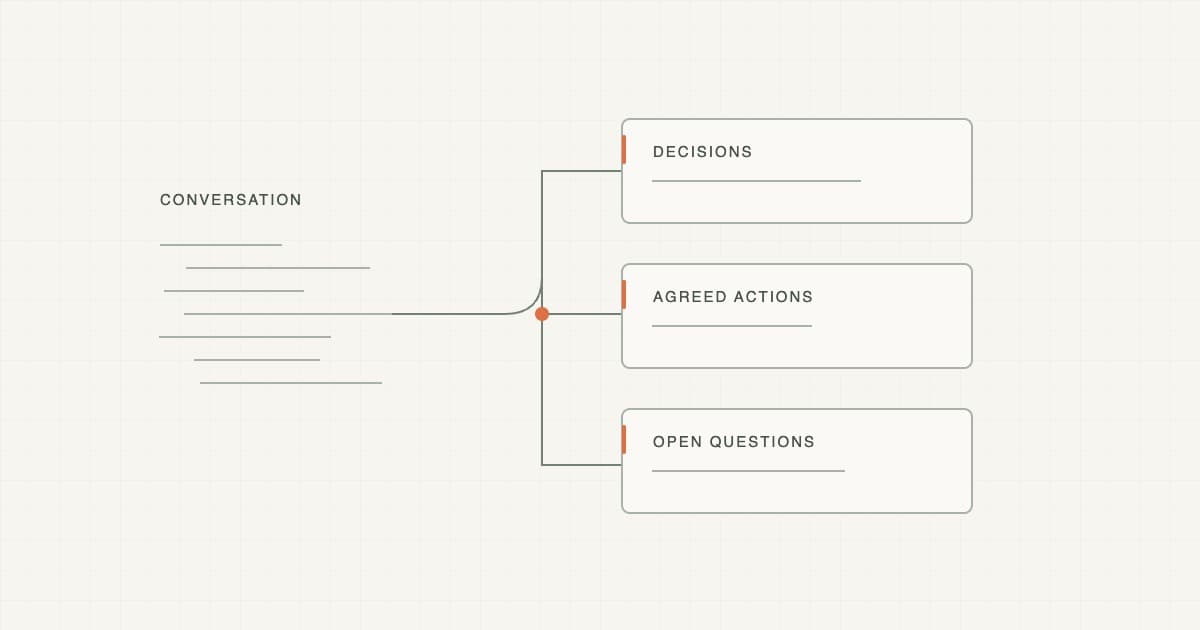
Use a small structure that separates decisions, agreed actions and unresolved questions. The template below works in an ordinary document or Markdown note, with or without AI.
The short answer
Include the meeting’s purpose, the decisions made, agreed actions with owners and dates, and questions that remain open. Add enough source context to check anything consequential.
Write “not agreed” when an owner or deadline is missing. A suggestion becomes an action item only after someone commits to it.
Copy this meeting summary template
Copy the following into your notes. Remove sections you do not need; leave a clear “none agreed” when the absence of a decision matters.
MEETING
Title:
Date:
Participants:
Purpose:
Source: [link to notes, transcript or recording, if available]

OUTCOME
[One or two sentences explaining what changed.]

DECISIONS
- Decision:
  Reason:
  Conditions or limits:
  Source:

AGREED ACTIONS
- Deliverable:
  Owner: [named person, or not agreed]
  Due: [date and time zone if relevant, or not agreed]
  Source:

OPEN QUESTIONS AND RISKS
- Question or risk:
  What would resolve it:
  Follow-up owner: [if agreed]

NEXT CHECKPOINT
[An agreed review point, or not scheduled.]
The source field can be a transcript timestamp, a link to the relevant note or a short attributed passage. It does not have to be a recording. If no source exists, say that the summary is based on the note-taker’s recollection.
Atlassian’s meeting-notes guidance similarly includes meeting details, discussions, decisions and actions with owners and deadlines. The template here adds explicit space for missing agreements and conditions so they remain visible. Atlassian’s template guidance
A worked example
Here is a fictional project discussion. The names, dates and commitments are illustrative.
Maya: Let’s keep the pilot to three customers until we finish the export check.
Arun: I’ll test export with the sample project and post the result by October 2.
Maya: Good. We should improve the onboarding email too.
Arun: I can look at that after the export test, but I’m not committing to a date yet.
Maya: Let’s review the export result on October 5 and decide whether to expand.
A useful summary would read:
Purpose: Decide whether to expand the customer pilot.
Outcome: The pilot remains limited to three customers while export is checked. Expansion will be considered at the next review.
| Type | What belongs in the summary |
|---|---|
| Decision | Keep the pilot at three customers pending the export check. |
| Agreed action | Arun will test export with the sample project and post the result by October 2. |
| Open question | How should the onboarding email change? No delivery commitment or date was agreed. |
| Next checkpoint | Review the export result on October 5 and decide whether to expand. |
The tempting mistake is to add “Arun: rewrite onboarding email by October 2.” He mentioned the email, but the deadline belongs to the export test. Combining the two creates a commitment that was never made.
Preserve conditions too. “Consider expansion on October 5” does not mean “launch the expanded pilot on October 5.”
Use AI for a first draft
Give the model the relevant notes or transcript and a bounded instruction. Use only material appropriate for the tool and processing mode you have chosen.
Draft a meeting summary from the source below.

Use these sections:
- Purpose and outcome
- Decisions, including conditions
- Agreed actions: deliverable, owner, due date
- Open questions and risks
- Next agreed checkpoint

Use only information present in the source.
Do not turn suggestions into commitments.
Do not infer owners or deadlines.
Write "not agreed" for missing commitments.
Keep conflicting statements visible.
Include a source timestamp or passage for each decision
and action when the input provides one.
Do not invent source references.
Do not send the summary or create tasks.

SOURCE:
[Paste the relevant notes or transcript.]
This prompt defines a draft format. It does not guarantee that a model will interpret every statement correctly. Check the output against the source before using it to assign work.
For a long meeting, start with the sections relevant to the summary’s purpose. Keep the surrounding discussion available so a qualification or later reversal is not lost.
Cue Meetings keeps the transcript and your notes together; its public page also describes summaries and follow-ups. You can use this template while reviewing that material. The template is an editorial workflow, not a claim that Cue automatically enforces these fields or creates tasks in other apps.
Review before sharing
Read the summary once from the perspective of a person who missed the call.
- Decisions: Was each point agreed, merely proposed, or left conditional?
- Ownership: Did the named person accept the work?
- Dates: Does each date belong to that specific action?
- Evidence: Can someone find the source for a disputed statement?
- Audience: Does this version include only information the recipients should receive?
Keep private observations out of the shared recap unless they belong there. “I think the customer sounded uncertain” is your interpretation; it should not become “The customer rejected the plan.”
For a small internal meeting, a short recap may be sufficient. For formal minutes or another prescribed record, follow the required format and approval process instead of treating this template as a replacement.
Store the reviewed summary somewhere the intended readers can find it. Send it deliberately. A draft in a notes app does not establish that anyone received or accepted the actions.
If you prefer to speak your first recap, use voice-to-text on Mac, then arrange it into the same sections. For choosing a capture tool, see the broader AI meeting-notes guide.
Frequently asked questions
How long should a meeting summary be?
Long enough to explain the outcome, commitments and remaining uncertainty. A short check-in may need only a few bullets. More complicated decisions need enough context to preserve the reasoning and conditions.
What is the difference between a summary and a transcript?
A transcript records spoken content in sequence. A summary selects and organizes the parts relevant to the reader. Keep a route back to the source when the exact wording matters.
What if no decision was made?
Say so. Record the question, any agreed investigation and the next checkpoint. An unresolved issue is a valid meeting outcome.
Should every action have a deadline?
Record an agreed deadline when one exists. If it does not, write “not agreed” and ask for clarification. An invented date makes the summary less reliable.
Can I use the template without recording the meeting?
Yes. Fill it from your written notes and confirm uncertain points with participants. Be clear when a detail comes from recollection rather than a transcript.
Sources
Checked September 29, 2026.
- Atlassian: meeting-notes template and recommended contents.
- Cue Meetings: transcript, notes and summaries.
The template, prompt and fictional example are original editorial material.
Explore Cue Meetings if you want your conversation and working notes in one place. Use the template with whichever tool you already trust.